UK food safety compliance
Food Safety Record Keeping: What to Keep, Why It Matters, and How Long to Retain Records
Your records are the evidence that keeps your food hygiene rating up and your due-diligence defence intact. Here is exactly what UK law expects you to record, and what the FSA and the regulations actually say about how long to keep it.
Last updated:
Why your records are your legal defence
When an Environmental Health Officer inspects your business, your records are the proof that your food safety management system is actually working. Missing or incomplete records are one of the fastest ways to lose points on the Food Hygiene Rating Scheme, where confidence in management is scored from 0 to 5.
Without records you also lose your strongest protection in court: the due-diligence defence under section 21 of the Food Safety Act 1990, which depends on documented evidence that you took all reasonable precautions and exercised all due diligence.
What food safety records you must keep
A food safety management system based on HACCP is built on records. These are the documents an EHO expects to see, and the ones that demonstrate the seventh HACCP principle, establishing documents and records, under Regulation (EC) 852/2004.
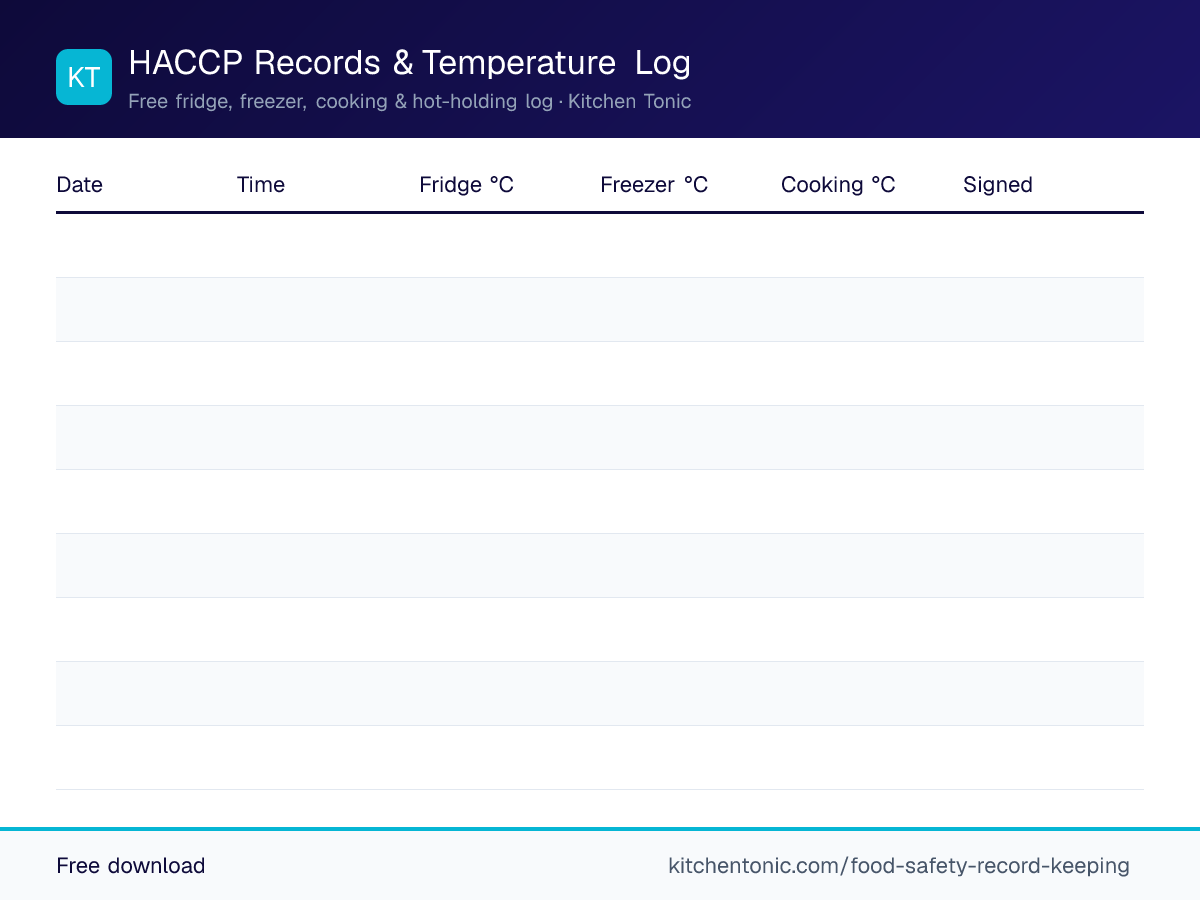
- Temperature monitoring: fridge, freezer, cooking, cooling and hot-holding checks
- Cleaning schedules and completed cleaning records
- Opening and closing checks
- Deliveries and goods-in checks, including temperature on arrival
- Allergen information for every dish and the 14 regulated allergens
- Supplier and traceability records, one step back and one step forward
- Staff training records and fitness-to-work declarations
- Corrective actions taken when something falls outside safe limits
- Your HACCP or food safety management plan itself
How long must you keep food safety records?
Here is the part most websites get wrong. UK food law sets no fixed number of months or years for keeping most food safety records. Regulation (EC) 852/2004 requires you to keep documents and records commensurate with the nature and size of your business, and to retain them for an appropriate period. The Food Standards Agency puts it plainly: it is for businesses to decide how long they keep their records, based on the shelf life of the food.
The only concrete numbers come from European Commission guidance on traceability, and even those are framed as what could be kept, not a legal minimum.
| Record type | What the law or guidance says | Legal or guidance | Source |
|---|---|---|---|
| HACCP / food safety management procedure documents | No fixed period. Must be kept up to date at all times. | Legal: Reg (EC) 852/2004, Art. 5(4)(b) | legislation.gov.uk |
| HACCP records (any other documents and records) | No fixed period. Retain for an appropriate period, commensurate with the nature and size of your business. | Legal: Reg (EC) 852/2004, Art. 5(4)(c) and 5(2)(g) | legislation.gov.uk |
| Traceability and supplier records (general food law) | No statutory minimum. Records must be available to authorities on demand. | Legal: Reg (EC) 178/2002, Art. 18 | legislation.gov.uk |
| Traceability: European Commission suggested periods | The Commission suggests, as a practical rule that 'could' apply: 5 years for products with no durability date; 6 months after sale or delivery for highly perishable foods (use-by under 3 months or no date); shelf life plus 6 months for products with a best-before date. | Guidance only: EC Article 18 guidance, 2010 | food.ec.europa.eu |
| Food of animal origin traceability | Keep available at least until the food can reasonably be assumed to have been consumed; update daily. | Legal, sector-specific: Reg (EU) 931/2011, Art. 3 | legislation.gov.uk |
| SFBB daily diary (routine monitoring) | Fill in each day. Keep completed pages until your next visit from a local authority food safety officer. | FSA guidance | food.gov.uk |
| Staff food-hygiene training records | No statutory retention period. The FSA recommends keeping a record so you can show it to officers. The training itself is a legal requirement. | Training: legal. Record: FSA best practice | food.gov.uk |
| Allergen information | Keep accurate and up to date at all times. No fixed retention period. | Best practice (accuracy is a legal duty) | food.gov.uk |
In short, there is no single legal retention figure. The safe approach is to keep each record at least as long as the food it relates to is on sale or could still be eaten, and to follow the European Commission traceability guidance above where it applies. If you want certainty, we will build retention rules into your HACCP system.
Food safety record keeping: your questions answered
How to set up a compliant record-keeping system
- 1
Map your hazards
Work through your menu and processes to identify the biological, chemical and physical hazards and the critical control points where they must be managed.
- 2
Choose your record templates
Select the monitoring records you actually need, from temperature logs to cleaning schedules, and keep them simple enough that staff will complete them.
- 3
Set monitoring frequencies
Decide how often each check happens and what the safe limits are, so a missed or failed check is obvious.
- 4
Assign responsibility
Make it clear who completes each record and who reviews them, so nothing is left to chance.
- 5
Review and retain
Review records regularly, act on anything outside safe limits, and retain each record for as long as the related food could still be in use.
- 6
Digitise where it helps
Move to timestamped digital records where you can, to cut admin and strengthen your due-diligence evidence.
We build all of this for you as part of a site-specific HACCP plan.
Explore our HACCP serviceRecord keeping by sector
Need the diary itself? The printed Safer Food, Better Business pack and the Scottish and Northern Irish equivalents are in the shop, delivered next working day when ordered by 12 noon.
Restaurants and hospitality
Daily monitoring, allergen matrices and delivery checks that stand up to an EHO visit.
Small producers and manufacturers
Traceability is heaviest here: full one-step-back, one-step-forward records and batch coding.
Care homes
Dual CQC and EHO scrutiny means your food safety records need to satisfy two inspectors.
Stop worrying about your paperwork
We will build a record-keeping system that satisfies your EHO and protects your due-diligence defence, then keep it current as your menu changes.
Sources
- Reg (EC) 852/2004, Art. 5 (HACCP; documents and records)
- Reg (EC) 178/2002, Art. 18 (traceability)
- Reg (EU) 931/2011, Art. 3 (food of animal origin)
- Food Safety Act 1990, s.21 (due-diligence defence)
- European Commission Article 18 traceability guidance (2010)
- FSA: Safer Food, Better Business
- FSA: Managing food safety